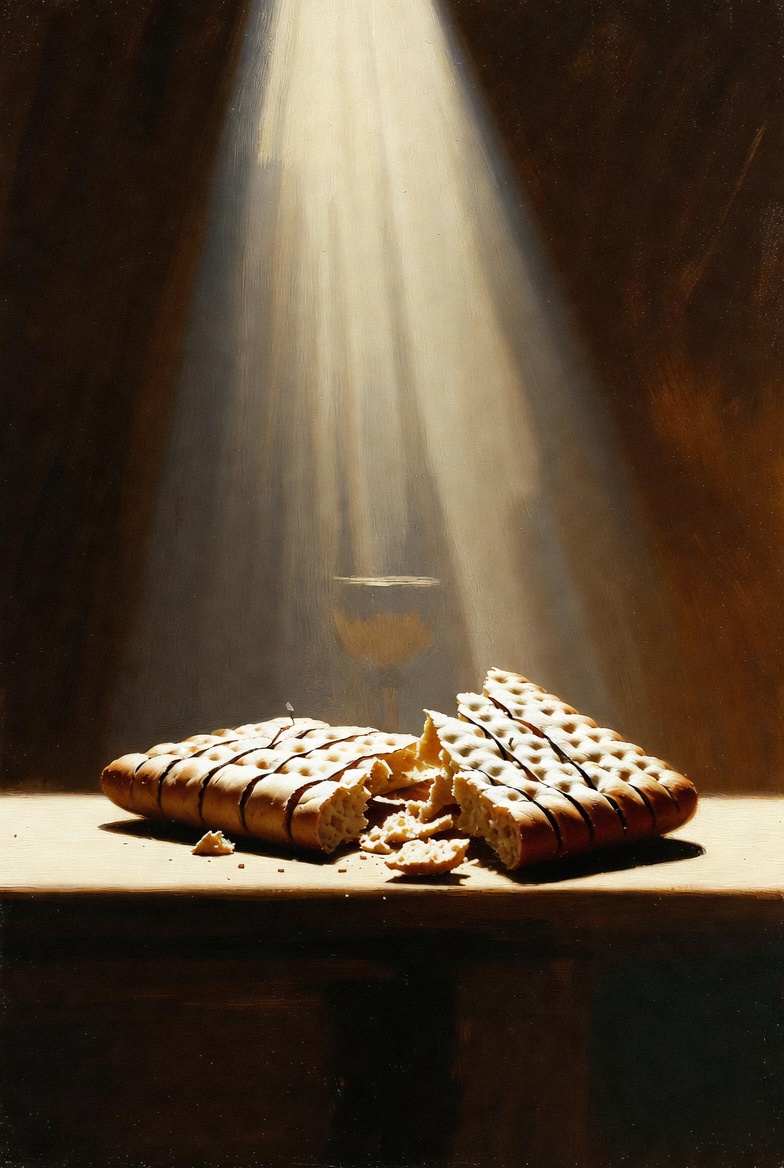
Christ in the Matzah / Unleavened Passover Bread
facilitated by Dox
Sources so far: Exodus 12:1-14, 1 Corinthians 5:7-8, 2 Corinthians 5:21, Isaiah 53/Matthew 8
The Matzah represents Christ. The Matzah was striped and pierced, as Christ was striped and pierced. Matzah was unleavened, just as Christ knew no sin.
With this in mind we can continue to receive healing and restoration by faith. Just as we received salvation, so we receive healing.
27 Therefore whoever eats this bread or drinks this cup of the Lord in an unworthy manner will be guilty of the body and blood of the Lord. 28 But let a man examine himself, and so let him eat of the bread and drink of the cup. 29 For he who eats and drinks in an unworthy manner eats and drinks judgment to himself, not discerning the Lord’s body.1 Corinthians 11:27-29
We have much to say and have heard much about the ‘unworthy manner’. We say we couldn’t take in the bread and wine until we ‘purge’ ourselves of sin so we are ‘worthy’.
But take note of where it says that the unworthy manner is ‘not discerning the Lord’s body.’ This isn’t about our performance but our remembering the Lord’s body being offered in our place. We are not qualified by our performance – we are qualified by His body.
We partake unworthily when we treat it as a meal, just as the Corinthians were rebuked for – they went there hungry and treating it as a feeding program instead of understanding what we remember Christ.
We partake unworthily when we come to this meal sin-conscious and performance-minded, instead of being Son-conscious and flowing in the Spirit.
We break bread with the brethren, remembering Christ and being thankful, and we receive healing, avoiding the curse. When we partake of the bread, we remember Christ took the curse, and our strength is renewed.
26 For as often as you eat this bread and drink this cup, you proclaim the Lord’s death till He comes.1 Corinthians 11:26
“As often” as we eat this bread and drink from this cup, meaning we don’t necessarily follow a schedule, but do it as much as we can. Often, in remembrance of Christ.
We take it in – and we are thankful and healed, but it all takes its foundation in our proclaiming the Lord’s death until His return. Why is it just the Lord’s death? Well, there’s a lot to take in from His death, just as much as there is from His birth, resurrection and so on.
His death proved He became sin, that we would become His righteousness. His death is seen as an ultimate act of love towards us by Christ, the ultimate demonstration of God’s grace towards us.
2 Beloved, I pray that you may prosper in all things and be in health, just as your soul prospers.3 John 1:2
In remembering His death we recognize His body was broken, and His blood was shed.
We take in healing for our physical bodies from the outside in when we eat the bread.
We take in restoration for our heart, soul and mind from the inside out when we take in the blood.
DECLARATION:
Thank You Jesus for Your broken body.
It is for my healing, my spouse’s healing and
my children’s healing.
Thank You that by Your stripes,
by the beatings You bore,
by the lashes which fell on Your back,
we are completely healed.
I believe and I receive.
Thank You Jesus for the new covenant cut in Your blood.
Your blood has brought me forgiveness and washed me from every sin.
I thank You that Your blood has made me righteous.
And as I drink, I celebrate and partake of the inheritance of the righteous, which is preservation, healing, wholeness and prosperity.
His body was broken so that I can be whole.
His blood was shed so that I can be forgiven, righteous, and blameless.
I come boldly to His Table.
I receive health, wholeness, and life.
Do it as often as we eat and drink, in remembrance of Christ. By no means a ritual, not magic, but remembrance.
In this season of stillness, we remember Christ, we discern His body, and we take in His provision, according to the riches of His grace.
In remembrance we remind our souls, ‘forget not His benefits‘.
Be still. Wait upon the Lord. Be expectant of His move, eyes open on what He does. Feel Him working. See Him working.
He prepares a table before us in the presence of our enemies. He anoints our heads with oil and our cup runs over.
We thank Him because this is for us, as lonely as the world would make us, or as unemployed we bring ourselves to be. We let the Lord, the Shepherd, the Host, prepare the table for us. We let Him anoint us – cleansing us and filling our minds as our bodies are nourished.
It’s funny how earlier we talked about waiting on the Lord as a waiter waiting for Him to move, and now we’re also talking about waiting on the Lord to prepare the same table.
It’s against the notion that when we talk about waiting on the Lord, we’re waiting to do something for Him, when what’s really being revealed here is that we’re waiting on Him to make the moves.
We’re doing a reverse JFK here: “Ask not what you can do for your God — ask what God can do for you.“
And actually, let’s add to that: ‘Ask what you can do FROM God. Ask what you can do THROUGH Christ. Ask what you can do WITH the Spirit.‘
Be still and know that He is God.
Wait on the Lord, and you will renew your strength.
Be strong in the Lord and be of good courage.
He is our Good Shepherd who is for us, and not against us.
He is our Refuge and our Fortress who is with us, and will never leave us nor forsake us.
He is our Father, and nothing can ever separate us from His love.
Thank You, Father, for these reflections.
Thank You, Jesus, for these revelations.
Thank You, Holy Spirit, for the rest.
Amen.
131650/365000


 JB's Personal Brain Defragmenter
Leave a comment