Today I want to write about giving.
What do you do if you’re not necessarily forced, nor coerced, but automatically just included in a pooling of finances; one that you understand is beneficial, but one you aren’t necessarily prioritizing?
What do you do if you’ve involved yourself in someone else’s financial troubles, and despite your stern setting of expectations regarding how much you’re willing to give, this person persists in asking for your help, specifically?
I’m not about to directly answer those questions, but I do want to float some concepts regarding giving to each other, in the body of Christ.
The first is the Jewish practice of Tsedakah. I went ahead and asked our (presently) good friend ChatGPT what it can gather regarding this practice:
Tzedakah is a Hebrew word that translates to “charity” or “righteousness.” In Judaism, Tzedakah is not merely about giving to those in need; it’s considered a moral obligation and an act of justice and righteousness.
Right off the bat, we’re challenged to broaden our perspectives regarding charity; To see giving not merely as reactive help, but proactive ‘(social) justice and righteousness’.
According to Jewish law, individuals are encouraged to give a portion of their income or resources to support those in need, and there are guidelines regarding how Tzedakah should be given, including doing so with sensitivity, dignity, and respect for the recipient’s privacy.
The western ideas we’ve been used to regarding tithing generally prescribes giving a tenth, but we see no indication here of an actual amount… and rather than our seeing a tithe primarily as an offering to the Lord, we see here that the portion we put aside to observe Tsedakah goes straight ‘to support those in need’… “not merely seen as an act of charity but as a way to fulfill one’s moral and ethical duties towards others and to contribute to the betterment of society as a whole.”
So again, it’s more of a proactive role. We don’t wait for someone to ask for help before we pool our resources together, but it’s the other way around – we collect what we can so we give “with sensitivity, dignity, and respect for the recipient’s privacy.… for the recipient’s autonomy and privacy. It’s important to avoid causing embarrassment or shame.”
Take note that it’s not only a more proactive approach, but a more discreet act as well.
So after this initial insight I followed up and asked, “say i was going to apply the concept of Tzedakah. how would they determine who gets the income or resources that are received?”
ChatGPT’s response tells us who we can direct the collected resources to first, and why:
Priority to the Poor: Priority is given to those who are most in need, particularly the poor, the hungry, the sick, and the vulnerable members of society.
Local Community: There is often an emphasis on supporting individuals and families within one’s own community or immediate surroundings, as there is a sense of communal responsibility and solidarity.
The AI continues with what to keep in mind in determining who gets what, and why they get the percentage they’re assigned:
Identification of Needs: Efforts should be made to identify genuine needs and prioritize assistance accordingly. This may involve working closely with community leaders, social service organizations, or religious institutions to assess needs and distribute aid effectively.
Fairness and Equity: Tzedakah should be distributed fairly and equitably, without discrimination based on factors such as race, religion, ethnicity, or social status.
Long-Term Impact: Consideration should be given to the long-term impact of Tzedakah, aiming not only to alleviate immediate needs but also to empower individuals and communities to become self-sufficient and resilient over time.
Stewardship: There is an emphasis on responsible stewardship of resources, ensuring that Tzedakah funds are used effectively and efficiently to maximize their impact on improving the well-being of those in need.
Overall, the process of determining who receives Tzedakah involves a combination of compassion, discernment, and adherence to ethical and religious principles, with the ultimate goal of promoting justice, kindness, and social welfare within the community.
Now that I read all this, these are guidelines we can take in, in case it’s agreed upon by the congregation that they can trust the administration with proper allocation of a portion of their income.
This seems to involve additional work from leadership, as they need to be (1) comprehensive in ensuring that all immediate needs are brought to their attention so as to avoid leaving out individuals and their circumstances, (2) practical in their ideas of empowering and drawing out the potential of people and families to be self-sufficient, and (3) responsible in handling the resources entrusted to them, by walking what seems to be a line between maintaining transparency and upholding decency.
Now that I’m thinking about it, there are possible issues that could arise if we were to adhere to this practice, in today’s congregation where trust is becoming more and more difficult.
Then again, this is a Jewish practice… We’re not going to rule this out altogether. There are a lot of things we learned from this. I specifically enjoyed how through the concept of Tzedakah we aren’t merely lifting people out of their negative circumstances, but we’re also to think about bringing the community forward by helping them to become self-sufficient.
It’s a Jewish practice, but I feel we should look at how the early Church moved. I’m reading through the Bible, going through the Gospels. I’m not in Acts yet, will get there soon, but I think I should go there now, in light of what we’re trying to resolve.
After the outpouring of the Holy Spirit and Peter’s speech at the marketplace, what we now know as the Church or the Body of Christ began to form, and more importantly, to move:
And they devoted themselves to the apostles’ teaching and the fellowship, to the breaking of bread and the prayers. And awe came upon every soul, and many wonders and signs were being done through the apostles.
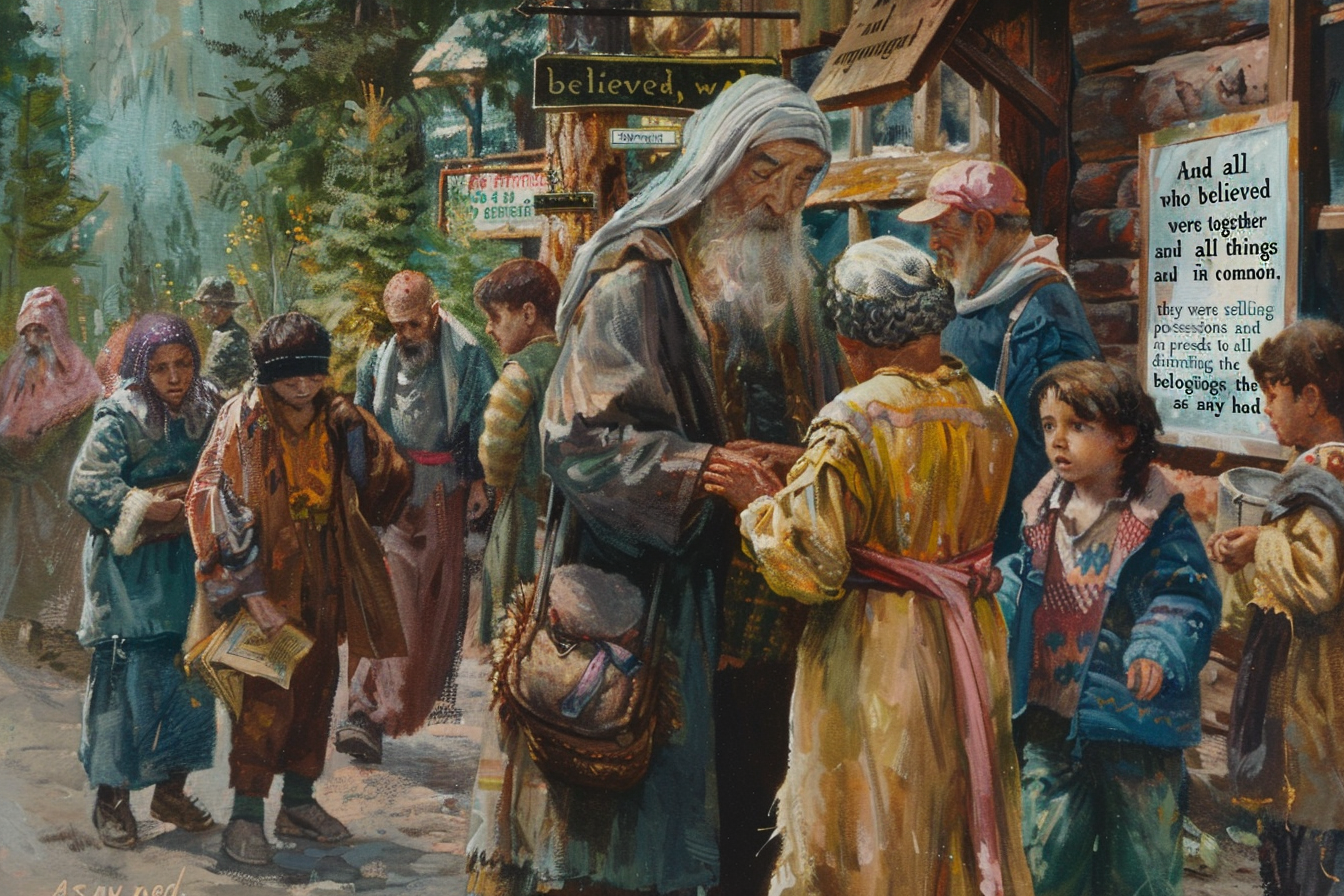
And all who believed were together and had all things in common. And they were selling their possessions and belongings and distributing the proceeds to all, as any had need.
And day by day, attending the temple together and breaking bread in their homes, they received their food with glad and generous hearts, praising God and having favor with all the people. And the Lord added to their number day by day those who were being saved.
Acts 2:42-47
….And how. I came into this with the intention of talking about giving, but it couldn’t be helped: Here we see another perspective of how our own gatherings can operate.
See that they didn’t just come together uniformly every week to ‘feed’ on what the pastor had to say, but much more than just consumption, they ‘devoted themselves’ – Perhaps a reminder for me not only to encourage action from the Word shared, but also meditation. They didn’t just come together for their own sakes, but to be with others with the same heart and mind, in fellowship…
And it appears that they communed – That is, they broke bread, not merely as an act of Holy Communion, I believe they all ate with each other, and we also read they prayed for one another.
We’re reminded or encouraged by Tzedakah to not only give as a reaction to the circumstances of the brethren, but also as a pre-emptive action to encourage the brethren to stand on their own.
But we read here that while Tzedakah encourages putting a portion aside, the Body of Christ was not only together in fellowship, but ‘had all things in common.’.. Even going as far as ‘selling their possessions and belongings and distributing the proceeds to all, as any had need.’
I’m going to stop right here and clarify that I’m not about to go ahead and make a diagnosis of how the way we do things now isn’t the same as how they did it back then… Nor is it my priority for us to take notes on what we can emulate from the Early Church, or from Tzedakah.
I think the priority we see here is mentioned in what was mentioned earlier, regarding devotion to teachings, fellowship and prayer. We reflect on the Word before anything else, and we shouldn’t be surprised if, every time, we come full circle with Christ, the Living Word, glorified.
Before anything else, we devote ourselves to fellowship, and prayer – Prayer, as only the Holy Spirit can lead us; He prays for us, if we aren’t being led to pray for ourselves or others.
And there it is – before we go ahead and run cartwheels through the nuances of giving, we would do well to remember what we have been given first: Christ, and through Christ, the Holy Spirit.
So with that being said, to address the situations we’ve mentioned at the start of this article, I say that if we can’t find an answer to it ourselves, we should devote ourselves to Scripture and the teachings, in fellowship, and in prayer.
It’s good to be reminded of what really matters, especially when too much focus is emphasized on the need. It’s good to be reminded of what we’ve been given, before we go ahead and make any decisions in our giving.
Let’s not deviate from the Truth of the matter here: We come together, not to feast first, not to give to each other first, but to fellowship in reflection of the Word, leading us to Jesus Christ, the Living Word, the Word of Life, and the Word made flesh.
To quote the good folks over at the worship collective known as Housefires: Life is a gift, and the Giver is good.
If symptoms persist, consult your Savior.
65997/365000
#Giving #Offering #TheEarlyChurch #Acts #NewTestament #Tzedakah #JewishGiving #GivingInspiration #Fellowship #Devotion #ChurchPriorities #JesusChrist #HolySpirit #Prayer #PracticalChristianity #BenefitsOfSalvation


 JB's Personal Brain Defragmenter
Leave a comment